
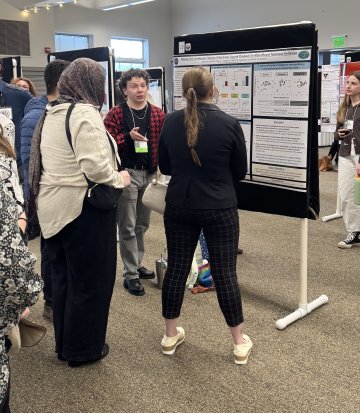
Chat and Mouse
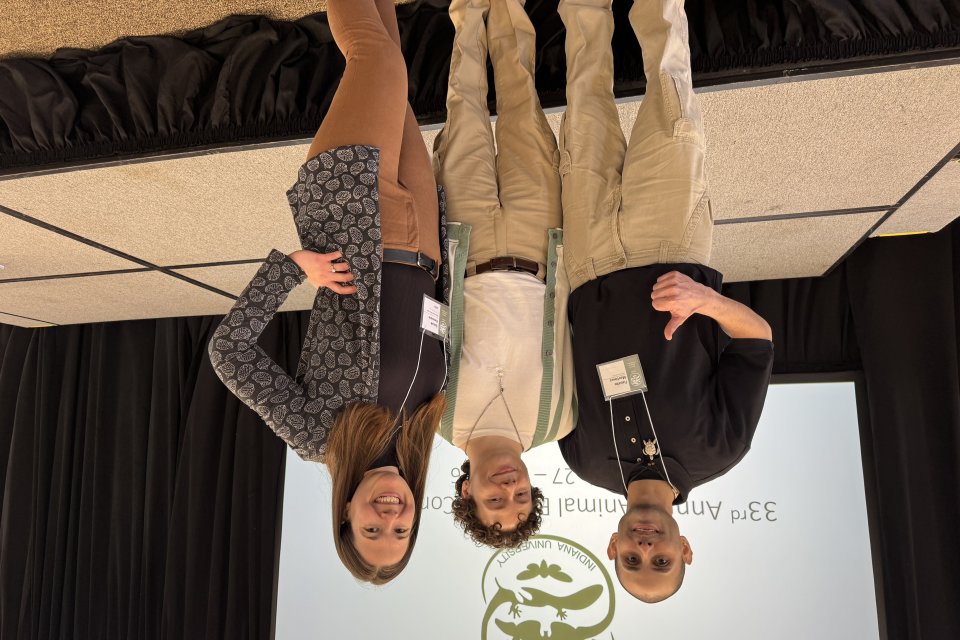
Student researchers join Dr. Sarah Keesom to chat and share findings with fellow Animal Behavior scientists
From medications to organ transplants, therapies to surgery techniques, much of modern science’s knowledge of human health finds its roots first in the study and understanding of animals, their physiologies, and their behavior.
For years, students of Professor Sarah Keesom have taken part in animal behavior research that holds the potential to unlock the secrets of even more human and veterinary mysteries. Just as importantly, they’ve also been able to share their knowledge and connect with some of the top scientists in the field.
In March, Professor Keesom along with students Marshall Hildreth '26 and Fausto Martinez '26, were among the more than 200 students and scientists at the 33rd Annual Animal Behavior Conference in Bloomington, Indiana. Organized by The Center for the Integrative Study of Animal Behavior (CISAB), one of the top centers for animal behavior research in the world, the conference offers animal behaviorists – including budding scientists like Hildreth and Martinez – the opportunity to meet and present their latest research.
Researchers can talk with fellow members of the scientific community and solicit feedback on their work, including advice on what to do next.
“An important aspect of attending conferences for my students has also been encouragement and seeing that other scientists are interested in what they are doing,” Dr. Keesom says. “I think it can be easy for students to see their research as an ‘island,’ when in fact, it is connected to the work of many past and current scientists.”
Students also get the opportunity to see how the concepts they've learned in research and in their classes are used by active scientists in the field.
“Fausto and Marshall both shared how exciting it was to see the terminology they learned in class now applied to new, cutting-edge research,” says Keesom.
Students also get the opportunity to network with researchers from across many areas of animal behavior.
“Marshall and Fausto are both senior animal behavior majors, and they were able to see talks and posters from researchers studying a range of questions and animal species, including elephants, chimpanzees, spadefoot toads, hamsters, chickens, cichlid fish, dung beetles, bobtail squid, and various species of birds, such as hummingbirds,” Dr. Keesom says. “And that's not a complete list.”
Martinez’s presentation, “Effects of nonlinear phenomena in female mouse squeaks on male mouse vocalizations” and Hildreth’s presentation, “Playing Chat and Mouse: Impacts of Nonlinear Squeak Playback on Male Mouse Nonvocal Behavior” intersects perfectly with Professor Keesom’s ongoing study of vocal communication and the role of serotonin within the auditory system.
“Marshall and Fausto's work complements my overall interest in vocal communication. I am particularly intrigued by mouse squeaks, in part because they are, surprisingly, highly understudied sounds in the mouse vocal communication world. I suppose I like rooting for the ‘underdog’ in research.”
In the past 20 years, most research, Dr. Keesom explains, has focused on mouse ultrasounds, which are whistles that humans cannot hear. In contrast, squeaks are produced in a way that is similar to some aspects of human speech (via vibration of the vocal folds); squeaks would therefore be a valuable tool for studying how the brain controls the production and interpretation of social sounds.
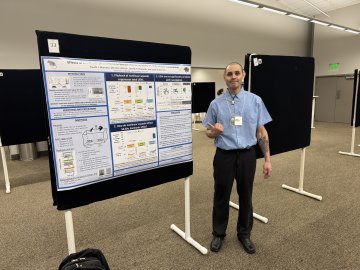
“First, though, we need to know what a squeak ‘means,’ and that's where Marshall and Fausto's research comes in,” says Keesom. “Their research has provided some of the first hints that mice are actually paying attention to differences in what a squeak sounds like, suggesting that different types of squeaks convey different meanings. It's very exciting!”
Dr. Keesom’s research has been ongoing for 16 years, with a lot of that work done with dedicated undergraduate students like Hildreth and Martinez.
“We've discovered many fascinating things along the way, and one of my favorites was when we demonstrated that not all squeaks are alike. I believe that one of the reasons squeaks have been ignored by some scientists is their belief that a ‘squeak is just a squeak,’ but now we know that is not true,” Keesom says.
One of her first undergraduate students discovered that female mice produce squeaks that sound different depending on the female's estrous state. As Dr. Keesom explains, female mice have a reproductive cycle called the estrous cycle, which is similar to the menstrual cycle in humans. This finding therefore suggested to Dr. Keesom’s research team that female mice could communicate reproductive readiness to males by making different types of squeaks. However, until Fausto and Marshall's research, they had no idea whether the male mice were listening to this signal or not
“Again, if we can attribute a function or ‘meaning’ to a particular type of squeak, we can then start to answer some other questions, such as how the brain decodes that meaning to produce appropriate behavioral responses to social signals,” Dr. Keesom says.
“What I found most interesting about our research is that it is the first to demonstrate that male mice are attentive to nonlinearities within female mouse squeaks,” explains Hildreth. “This has now opened up a treasure trove of experimental questions and possibilities.”
Shared Successes
All the scientific revelations that this research has led to have been achieved thanks to the involvement of Utica University students such as Hildreth and Martinez, who helped bring the research project to life. The duo helped to take a method the team had read in a scientific paper and develop it for use in their lab at Utica.
“In fact, this project would not have seen the light of day without them,” says Dr. Keesom. “They helped to run the experiments where we played different types of squeaks to male mice to ‘ask’ the mice what a squeak might mean. Marshall and Fausto also observed all of the experiments and analyzed the data, and they have both brought unique observations that helped to move this project forward. As we know, observation is the very start of the scientific process, so the more that we notice as a research team, the better our science will be. Lastly, it's also just more fun to include students!”
The team of researchers meet to talk about their results and read papers together in their weekly lab meetings, engaging in stimulating conversations.
“Science is best when it is shared,” Dr. Keesom emphasizes.
Legacy of Mentored Learning
“Dr. Keesom was a guiding light throughout my research,” Hildreth says. “Her passion and thoughtfulness were infectious, making for a smooth and welcoming foray into animal behavior research. Attending this conference allowed me to find community through science and to grow as a budding professional within ethology. Without Dr. Keesom, none of the above would have been possible.”
Although students such as Hildreth and Martinez graduate as have other members of the research team before them, new students join the lab and take up the reins, creating an ongoing legacy of minds committed to forwarding this unique research.
“Alums maintain an active interest in the project and usually ask me for updates. I've also had alums from my lab chat with my current students, which helps current students see what might be next for them when they graduate and gain advice from those who are just one or two steps ahead of them.”
As both a researcher and a faculty member overseeing these rising scientists, Dr. Keesom feels immeasurably proud of the work that they have done on this project and the talents and skills that will take them even farther.
“I've known Fausto and Marshall since they took my Animal Behavior course, so I've seen how they've grown since then. It's amazing to see them now as scientists in their own right, discussing their results with some of the top researchers in animal behavior.”
More Stories
Evan Andrews and Thaddeus Luke Receive Associated General Contractors of New York State Scholarships
Utica University Construction Management majors Evan Andrews ’27 and Thaddeus Luke ’27 have been awarded scholarships by the Associated General...
Dr. Christopher Riddle Awarded Prestigious Clark Endowed Professorship
Distinguished Professor of Philosophy Dr. Christopher Riddle has been awarded the prestigious Harold T. Clark Endowed Professorship. The award is...
WPNR-FM Sets New Mark With Record Game Broadcasts
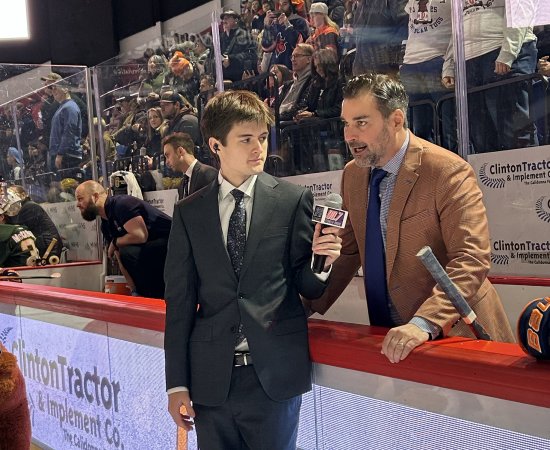
WPNR-FM staff members called a record 140 games over the Empire 8 Digital Conference Network with the help of Utica University’s Sports Information and Athletics departments.
I would like to see logins and resources for:
For a general list of frequently used logins, you can also visit our logins page.