

Common interests, global perspectives – Dr. Luke Perry reflects on time abroad as a Fulbright Scholar

“It really pushes you to be a better teacher, because you have to explain things to audiences from other countries, other cultures, as well as you possibly can, and make sure that students understand.”
When Dr. Luke Perry, distinguished professor of political science at Utica University, was selected by the U.S. Department of State and the Fulbright Foreign Scholarship Board as a Fulbright Scholar for the 2025-2026 academic year, it meant spending the Fall ’25 semester teaching in Budapest, Hungary as the Fulbright Laszlo Orszagh Distinguished Scholar in American Studies.
It was a process that took roughly a year from the time he first applied to the moment of acceptance.
“It's quite an intensive application process,” Dr. Perry explains. “You put together a multi-faceted application, and then there's various points of review that you go through, and you get updated each time. I was very fortunate to be successful.”
This particular application period came during a time of administrative transition for the U.S. government, and with a different administration came different perspectives on spending and with it, the impact on programs like this.
“We haven't had normal budgeting in American government for several years, and by that, I mean the budgeting process that Congress laid out for itself,” Dr. Perry explains. “So there were some budget considerations that went into this and different perspectives on how government money should be spent in this capacity. One of the reasons I found out later than usual was because the Hungarian Fulbright Commission wasn't entirely sure that they were going to be getting all the money that the U.S. government said they would provide, but ultimately it came through, and all the grants to that country were secured. So, while it took a little longer, we got there.”
The award is Perry’s second Fulbright, though his first Distinguished Fulbright Scholarship, which is widely considered the most prestigious Fulbright appointment. Through this fellowship, he was based in Budapest, Hungary, teaching at Eötvös Loránd University and Pázmány Péter Catholic University.
“Budapest is really two areas that are put together, ‘Buda’ and ‘Pest,’ that are separated by the Danube rivers,” Dr. Perry says. “I got to teach a graduate class and an undergraduate class in different parts of the city, which was an extraordinary experience.”
Being selected for the prestigious and highly competitive international education exchange program also meant not only bringing his expertise in political science and American elections to new audiences abroad, but also the opportunity to engage in conversations on those topics from a European perspective.
“Europeans, particularly students, are very interested in America. They see American culture everywhere from movies, television, music, shopping, restaurants, and food. They feel they have somewhat of a glimpse as to what America is like through the lens of those things, but they're very curious what it's really like. So that's sort of the entry point to build relationships with European students. They like hearing directly from somebody who's in America about American society and Americans. And of course, in my line of work, American politics, there is a lot of curiosity and concern on behalf of Europeans in terms of what our government is doing.”
In a position to try and answer their questions and explain the American government’s actions contextually in terms of what’s happening currently, Dr. Perry was able to provide different perspectives on a myriad of issues and how those various perspectives translate into federal governance.
Challenges to democratic governance
He’s traveled all over the world and has dealt with different types of political systems, from democratic to fairly oppressive. When it came time to spend several months as a U.S. citizen in Hungary, he at first was preparing for the worst, but says those fears didn’t come to fruition in the end.
“I didn't have concerns about my freedom of speech or freedom of movement, or being surveilled, or any of these types of things that you might be concerned about like being shaken down by law enforcement. I've experienced that elsewhere. The police in Budapest are really very nice, and so those things weren't a concern for me personally. That’s not to discount the challenges that Hungarians face in terms of their government which, in some ways, is similar to us.”
The political divisions that Dr. Perry found in Budapest were somewhat reflective of the divide he sees in the United States, often split among urban and rural populations in the country, which is roughly the size of New Hampshire.
“Budapest is largely liberal and very critical of the Orban regime, which is where I was. The rest of the country is predominantly rural and more supportive of the Orban regime. So there are certainly divisions, and there's a competitive election coming up there this year where Orban could lose power for the first time in a long time, though that remains to be seen. He’s also done a lot to consolidate his power in undemocratic ways.”

In addition to the classes he was teaching at the two universities, Dr. Perry was also traveling throughout Hungary and nine other countries throughout Europe giving guest lectures at various other institutions. He spoke on two major topics branching out of his research on U.S. elections, including his most recent book, “The 2024 Presidential Election: Key Issues and Regional Dynamics” as well as a myriad of current political issues.
“Europeans have a lot of questions on a lot of issues, such as gun violence, about the deployment of the military in our streets in terms of immigration enforcement.”
Speaking to packed auditoriums throughout Europe, Dr. Perry would highlight a handful of issues attendees were interested in, speaking for roughly an hour before another hour of question and answers with the crowds. Now back home, Dr. Perry is bringing those experiences and lessons from overseas to his classes at Utica University.
“It really pushes you to be a better teacher, because you have to explain things to audiences from other countries, other cultures, as well as you possibly can, and make sure that students understand.”
Perspectives on American politics
During the Spring 2026 semester, Dr. Perry is teaching a Special Topics course inspired by his experiences, called “Current Political Issues.” The premise of the course is to present Utica students with all the issues going on in America that have captured the minds of European students, the questions they have, and their thoughts on the matters – then asking Utica students how they’d respond. It provides him with the opportunity to share what he’s learned, and gives students the chance to reflect, process, analyze, and react to the comments from their European counterparts.
The topics that interested audiences in Europe the most? The status of Democracy in America, what they hear in the news about the federal government’s actions, what it feels like to be living in the U.S. amid these circumstances, and the perspective of a political science professor with a research background in democracy. Many in Hungary told him they were no strangers to democratic backsliding.
“Hungary has been invaded numerous times, and survival is paramount in their cultural ethos, so there's a lot of frank assessments in terms of where we're at. One professor I'll never forget, said to me over lunch, ‘It’s over. You had a good run and the longest written constitution. It lasted 100 years.’”

Getting such perspectives of current events from those peers in another country was at times sobering, whether it was on the degrade of checks and balances within government, to how a country like the U.S. reacts to consistent gun violence.
“The way we handle guns in our society is so much different from the rest of Western civilization. So they really just can't get their heads around the why and want to know how are we letting kids getting shot in schools, regularly. They don’t understand why that happens and are both horrified and curious at the same time. It's that human element they're searching out. They want to know how it makes you feel, how you process it, what’s being done. It’s big, tough issues they care about.”
It was also hard not to notice the deteriorating relationship between the United States and Europe – a historic alliance, particularly since World War II, that has now been left strained and damaged, the extent of which remains to be seen.
“They had a lot of questions about what Americans think about that. There were specific policy questions about our national security strategy that came out while I was there. They wanted to know American’s thoughts on that, but unfortunately most Americans aren’t aware of the National Security Strategy and what's in there. Most Americans are not particularly interested or consider themselves knowledgeable about American government. When they are, they tend to focus more on domestic issues.”
That led to another topic of interest to Europeans, who, when learning how the economy is consistently a top issue, year in and year out for election cycles, could not wrap their heads around such a concept.
“That really blew their minds. To them, sure, the economy is important, but it goes up, it goes down, but life is so much more than money. They think that we Americans live to work, whereas they work to live. So many of their curiosities and questions are coupled with this idea of ‘Why do you work so much? What is the point? Does that make you happy? Is that fulfilling?’ These are some of the types of things that that were on their mind in terms of American culture..”
Building greater understanding
Despite the growing popularity of Political Science as a major, Dr. Perry found through his encounters that Europeans were often more informed about American government than many Americans.
“Some of this is because of America’s powerful position in the world. If you have any interest in politics, you have to know what's going on in American government. That's part of it. I also think it's just a different societal approach to education. Europeans learn multiple languages. Everybody speaks English now, even more so than they did five or 10 years ago. They know a lot about not only their own history, but World History. You also have focus on international affairs. All these things are ingrained in their educational system in a way that they're really not in the United States. Some of that, I think, comes down to our power position and needing to know what's going on here. Some of it is that they just handle education differently, in a more international way.”
While globalization is nothing new, having been the norm several decades, Dr. Perry says Europe has for a long time now put far greater focus within their childhood education on preparation for a global society than America does.
"This was just an extraordinary opportunity to connect with all kinds of different people that I could learn from and develop relationships with."
“That lack of understanding or lack of global awareness probably has also played a large role in where we are today. Some of this is geographical. Here in the United States, you’ve got two huge oceans on either side of you, and then just two countries to the north and the south. Meanwhile, the little landlocked country of Hungary has seven neighbors, and historically is located where different tribes, civilizations, and countries were coming and going. Geography has provided us a lot of safety, and we've been spared a lot of the destruction of modern warfare. But perhaps the negative byproduct of that is that we tend to have less interest and engagement globally because it isn't as pertinent to our security. That complacency has led to a lack of awareness of what is going on throughout the rest of the world.”
With all this time spent engaging with other cultures, other governments, other educational systems and norms, one might find it difficult to pick a notable moment from throughout these travels. For Dr. Perry, what it really comes down to, is the people.
“It’s therelationships - getting to meet people from all over the world that you have similar interests with but have different backgrounds. I really like being around people I can learn from, so this was just an extraordinary opportunity to connect with all kinds of different people that I could learn from and develop relationships with.”
And while most of those relationships and interactions were positive, those that weren’t proved to be no less instructive.
“During the first week, I asked my students in one of my classes in Hungary, what do you want to learn about America? And one of the responses was from a student who asked ‘Why do Americans like making everything worse for everybody else?’ That was a really sobering and challenging question that has continued to make me think about not only my service overseas, but about our society, how we think about the world, and who we are. So that's something I will always remember. I'm grateful the question was raised. I hopefully provided an honest, empathetic answer that contextualized who we are and what we do.”
More Stories

Prospective Students Can Discover Utica at Fall Open House
Utica University will host fall Open Houses on Saturday, October 17, and Wednesday, November 11. Prospective students and their families...
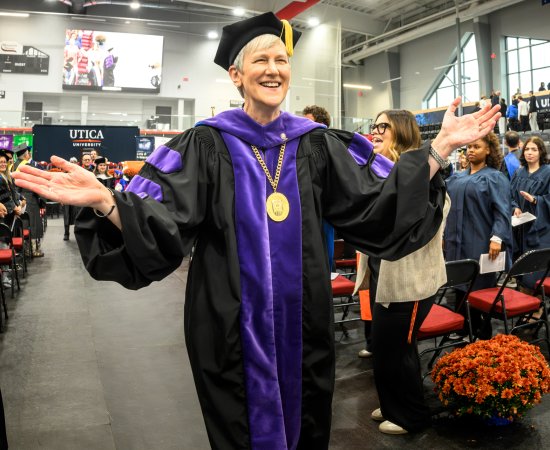
Dr. Stephanie Nesbitt officially becomes Utica’s 11th President
With October 1 came a new month in a new season and the marking of a new chapter for Utica...

Institute for the Study of Integrative Healthcare launches new Student Affiliate Program
A new program launched by the Institute for the Study of Integrative Healthcare hopes to engage students from all areas...
I would like to see logins and resources for:
For a general list of frequently used logins, you can also visit our logins page.