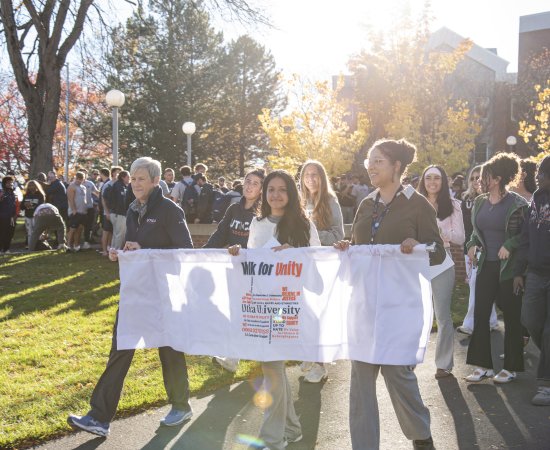
Stronger Together – Unity Walk 2026
Putting feet to pavement amid the golden rays and the autumn colors as rich and multiple as the backgrounds and...

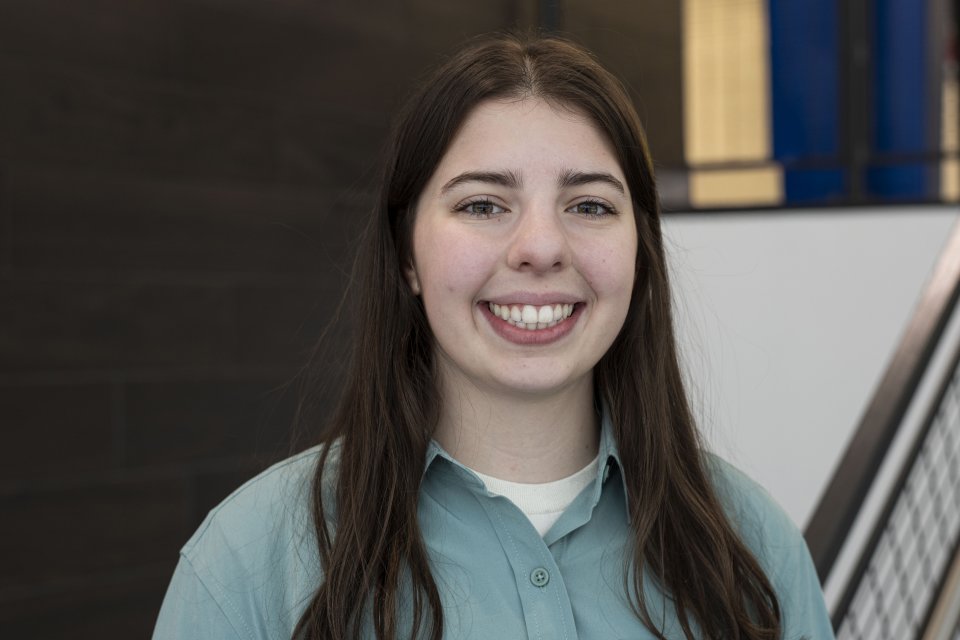
Taking an active role in Dr. Hava Turkakin’s space storm research has Sydney Kinsella ’26 reaching for the stars
For centuries, human beings have looked to the stars in search of meaning.
Sydney Kinsella ’26, along with her Physics Professor Dr. Hava Turkakin, have taken up this age-old practice in the form of a grant-funded research project, gleaning knowledge from the heavens and examining how certain space phenomena impact our lives on Earth in ways we may have never imagined.
A Chemistry major with a concentration in Adolescence Education, a Physics minor, and President of Utica University’s Society of Physics Students, Kinsella’s role in this research involves studying the Northern Lights – specifically, what happens in Earth’s magnetic field far out in space that helps to create this amazing celestial phenomenon.
“Out behind Earth, there’s a region called the magnetotail where streams of charged particles move around like winds in space,” Kinsella explains. “Sometimes these become unstable and send energy rushing toward Earth’s atmosphere. When that energy arrives, it can trigger things like auroras (the Northern Lights) and space storms. My research examines how and why these particle flows become unstable, what types of waves and motions form when they do, and what ultimately causes them to break apart.”
There is an immensely practical application to this inquiry, Kinsella adds. “Understanding these processes helps us better predict space weather — the kind of activity that can interfere with satellites, GPS, power grids, and communications on Earth. In short, our work helps us understand notjust why the northern lights occur, but also how to better prepare for space events that impact modern technology.”
The research into how space storms influence everything from weather to satellites has grown at Utica in recent years, thanks to a grant from the National Science Foundation. That award is helping to provide university students like Kinsella and local high school students with research opportunities that spark curiosity and raise awareness about the critical role space weather plays in the world today.
Burning brightly
Growing up in Schuyler, New York, just twenty-five minutes from campus, Kinsella was already familiar with Utica when it came time to pursue higher education.
“Staying close to my family was important to me, and I already felt connected to the campus,” she says. “Growing up with my mom as a faculty member [Associate Professor of Occupational Therapy Annmarie Kinsella] meant I spent a lot of time here. When it came time to choose a school, this campus already felt like home.”
Her strong interest in science as a child only grew when she got to high school, making her science classes the highlight of her day. That enthusiasm carried over to Utica, and while taking Physics 152 in Spring 2024, she approached Dr. Turkakin about pursuing a Physics minor. This, in turn, led her to attend the Society of Physics Students club meetings on campus, where she met fellow physics students and faculty members. Before long, her enthusiasm started burning brighter than the Northern Lights.
“At the end of the semester, Dr. Turkakin approached me and asked if I would be interested in doing space research with her over the summer,” she says. “After she explained the research details, I knew I was immediately on board!”
Working collaboratively on the project, Kinsella and Dr. Turkakin were joined by four high school students in the summers of 2024 and 2025, allowing Kinsella to step into more of a mentoring role.
“Teaching them what I had learned was a rewarding experience and helped me grow as a leader. This especially helped me gain knowledge for my future profession as a secondary school science teacher.”
While she continues to learn about the impact space weather is having on Earth, Kinsella is finding that the experience of doing scientific research has had a serious impact on her as well.
“As a student, I found it pushed me beyond classroom learning and gave me hands-on experience in real scientific work,” she says. “I learned how to read research papers, analyze data, and communicate my ideas clearly, especially when preparing presentations. As a scientist, attending the international AGU conference in Washington D.C. was a turning point for me. Presenting my poster, listening to talks, and meeting researchers from around the world helped me see myself as part of the scientific community. I also had the chance to give my own talk during Student Research Day at Utica University, which strengthened my confidence and communication skills.”
There were personal impacts, as well. “I learned from these experiences how capable I am when I take on challenges. Traveling, presenting, and engaging with others made me more confident, independent, and excited about my future. Looking back, I’m proud of how much I’ve grown through this project, and I’m incredibly grateful for the opportunities it has given me.”
She attributes this remarkable growth to the dedication of her research mentor, Dr. Turkakin. “She always believed in me,” says Kinsella. “Her support, patience, and guidance have shaped not only my research but also confidence in my ability to contribute to science.”
Helping others love science
In addition to personal growth, Kinsella says there were some surprises along the way, as well.
“Many people are surprised to learn that the northern lights are just one visible sign of a much larger system of energy flowing around Earth, which can seriously affect satellites, GPS, radio signals, and even power grids,” she says. “Amazingly, something that happening tens of thousands of miles away in space can have real effects here on the ground.”
Following graduation, she hopes to look into master’s programs that will allow her to continue her research and eventually spread her love of science in the classroom as a secondary school teacher in chemistry and physics.
“I want to help students love science rather than being intimidated by it. In the long term, I would love to continue my education and keep growing in the field.”
Whether in the classroom, in the lab, or deciphering the Northern Lights, Kinsella says the opportunities she’s had at Utica will continue to light her way forward, wherever her journey may take her.
“Regardless of where I go after graduation, the opportunities I’ve had here have shaped the way I approach challenges, communicate ideas, and work with others. Presenting my research has taught me how to speak about complex topics clearly, think on my feet during questions, and feel confident sharing my work with new people,” says Kinsella.
Her role as President of the Society of Physics Students has been equally as important.
“It put me in a leadership position where I learned how to organize events, support other students, and help build a sense of community within the department. Those experiences pushed me to step out of my comfort zone and develop a sense of responsibility. Together, my research, involvement in SPS, and overall time at Utica have helped me grow into someone who is more confident, capable, and ready for whatever comes next.”
For a general list of frequently used logins, you can also visit our logins page.